MILOSSI / LENS NOTES
Nylon, polycarbonate, CR-39 and TAC: choosing a lens
A guide to choosing a material, understanding its limits and developing lens and frame together. From the uncut disc to final assembly.
Choosing a lens starts with its use
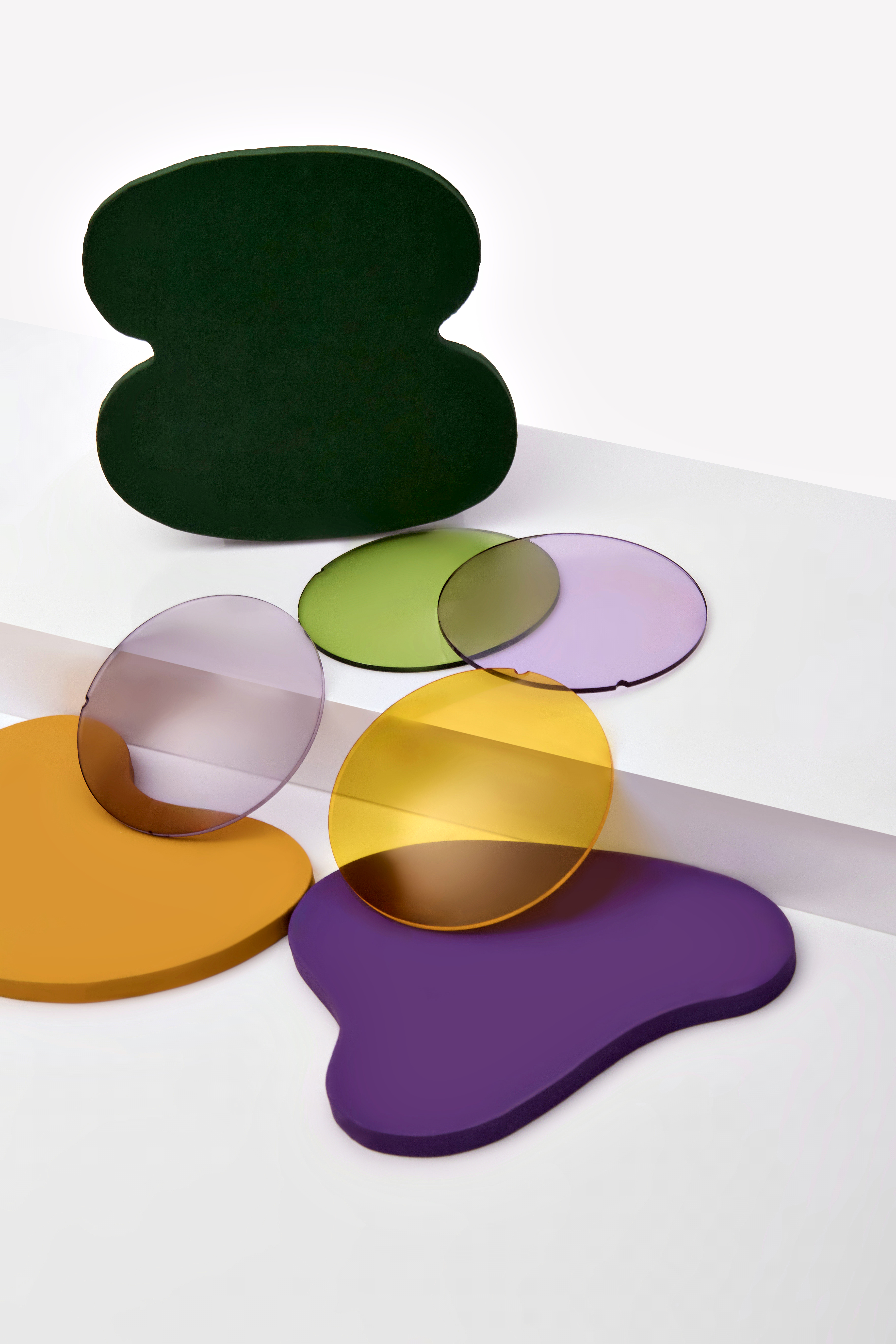
Two lenses of the same colour can behave very differently. The material affects weight, light dispersion, impact resistance and machining possibilities. The frame, curvature, thickness and coatings complete the picture.
For a sunglass collection, the useful question is: what does this lens need to do, and which frame will it work with? An everyday acetate frame and a wraparound sports shield start from different requirements. This guide focuses on sun lenses; prescription lenses add specific optical requirements.
What each material offers
| Material | Where it makes sense | What to check |
|---|---|---|
| Nylon / polyamide | Lightweight eyewear, large or wraparound designs and collections with acetate frames. A useful candidate for drilled lenses and complex shapes. | Optical grade, hard coat, stiffness, thickness and permitted drilling or grooving processes. |
| Polycarbonate / PC | Projects that prioritise impact resistance, especially with compatible injection-moulded frames. | Chemical compatibility, scratching, mounting stresses and optical limitations. Avoid standard acetate without validation. |
| CR-39 / PADC | Everyday collections that prioritise optical clarity and a wide choice of tints and gradients. | Lower impact resistance than PC; confirm thickness and suitability for demanding mounts. |
| Laminated TAC | Thin polarised sun lenses when the supplier’s construction and pricing suit the project. | Interlayer adhesion, thermal stability, humidity, thickness and retention in the frame. |
| Trivex | Projects combining low weight, good optics and resistance; particularly interesting for prescription lenses and rimless frames. | Available base curves, colours and sun-lens finishes, plus the cost of the complete solution. |
| Mineral glass | Collections that value optical quality and surface scratch resistance. | Weight and breakage behaviour; it would not be the starting point for a project with impact risk. |
Nylon does not mean any transparent plastic
In sun lenses, “nylon” usually refers to optical-grade polyamides. ZEISS highlights their low weight and compatibility with acetate, metal, injection-moulded materials and rimless mounts. This makes them versatile candidates for combining design and comfort. A lens-grade polyamide should not automatically be confused with the grade used to make a frame. For a collection worn for many hours, we would compare the complete prototype’s weight and visual quality alongside the material data sheet. [1]
Polycarbonate: impact-resistant, sensitive to the complete system
Its impact resistance explains its use in sports. That does not make it immune to scratching, chemicals or mounting stresses. It has greater chromatic dispersion than CR-39, so optical design and centration also matter. For its sun-lens range, ZEISS advises against mounting it in acetate and does not recommend drilled or rimless designs: follow the instructions for the selected lens rather than automatically transferring practices from other ranges. [2] [3]
CR-39: optics and colour freedom
This is a thermosetting resin, also called PADC. Although part of its chemical name resembles polycarbonate, it is a different material. Its optical quality and ease of tinting make it attractive for fashion eyewear, soft colours and gradients. As a starting point for an everyday acetate collection, we would compare CR-39 with nylon: the former for colour and optics, the latter for weight and design flexibility. We would not choose CR-39 as the main option when impact resistance is the priority. [4] [5]
TAC: the construction matters as much as the name
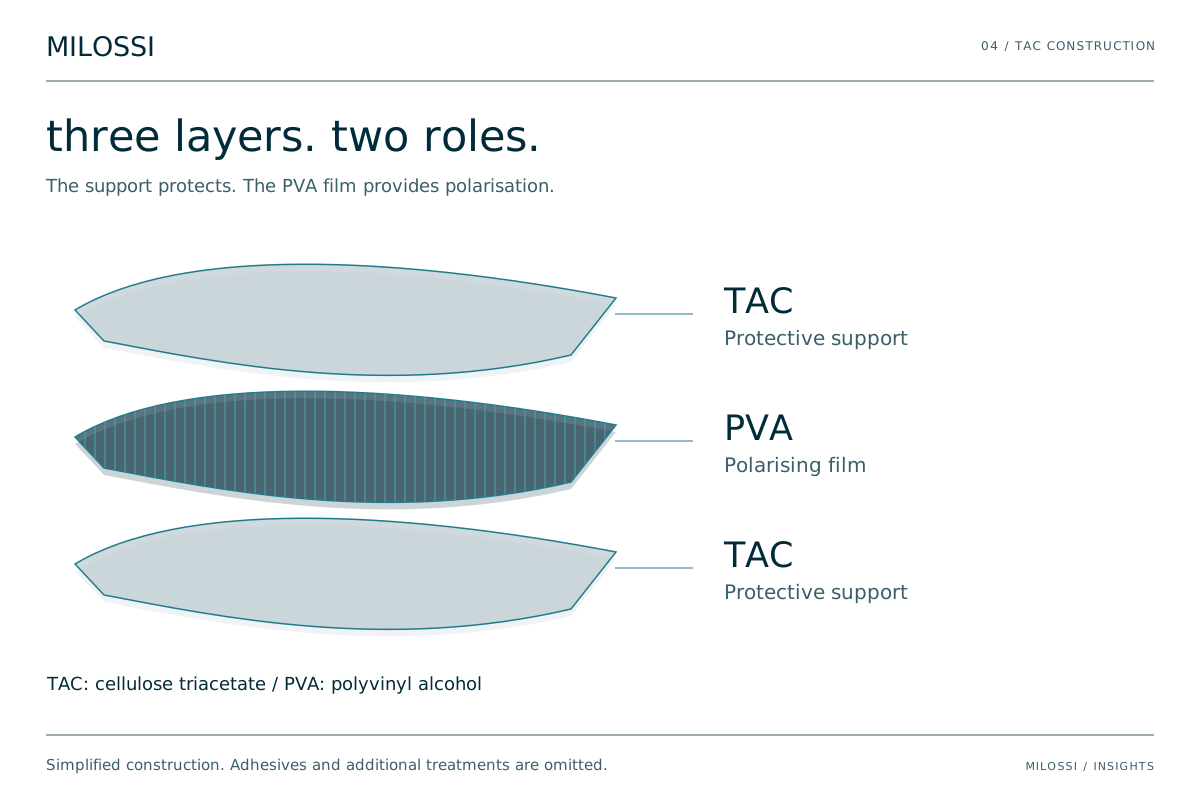
TAC means cellulose triacetate. In many commercial polarised lenses, a polarising PVA film is protected between TAC layers. That film provides the polarisation; the word TAC alone does not describe the entire lens. A TAC laminate and a solid PC lens should therefore not be compared as if only the plastic changed. [6]
Japan Eyewear, for example, offers 0.8 and 1.0 mm TAC in several curvatures. These are specifications for that range, not a universal standard. In a project, we would request ageing tests and tests of the completed assembly before fixing thicknesses or promising durability. We would not specify drilling or grooving without the manufacturer’s approval. [7]
Trivex, NXT and high-index materials
PPG presents Trivex as a combination of low weight, resistance and optical quality, suitable for drilled mounts. It is an alternative to assess when the lens also contributes to the eyewear’s structure. A trade name such as NXT should come with its data sheet: we would not assume that all formulations, photochromic versions or treatments are interchangeable. [8]
High-index materials deserve a separate mention for prescription lenses: they can reduce thickness, but are not an automatic improvement for a non-prescription sun lens. Acrylic demonstration lenses should likewise not be confused with finished, verified solar filters. [5]
Polycarbonate and acetate: a problem to anticipate
With standard-formulation cellulose acetate, incompatibility can be chemical as well as mechanical. Mazzucchelli explains that plasticiser can migrate into polycarbonate, cause opalescence and reduce its strength. The manufacturer proposes M49 as an alternative when PC lenses are required. [9]
For a new collection, our recommendation would therefore be to avoid PC with standard acetate unless the suppliers explicitly validate the combination. A lens fitting the prototype is not enough: the assembly’s behaviour over time must be checked. Divel also advises against this combination in its sun-lens materials guide. [5]
Specifications should refer to microcracks, opalescence and loss of strength, rather than simply saying the lens “chips”. An oversized lens, unsuitable bevel or certain solvents can introduce other damage mechanisms. These problems are related but not equivalent. [10]
For an acetate frame, we would start by assessing nylon or CR-39 according to the design. If polycarbonate is required, we would first define the acetate formulation and validate the assembly with both manufacturers.
How a lens arrives and how it is edged
A lens can arrive as a disc with finished optical surfaces but without the frame’s outline; as a preformed shield; or as a semi-finished blank that needs further optical processing. “Uncut” and “semi-finished” do not mean the same thing. The second term describes the state of the surfaces, not just the external shape. [11]
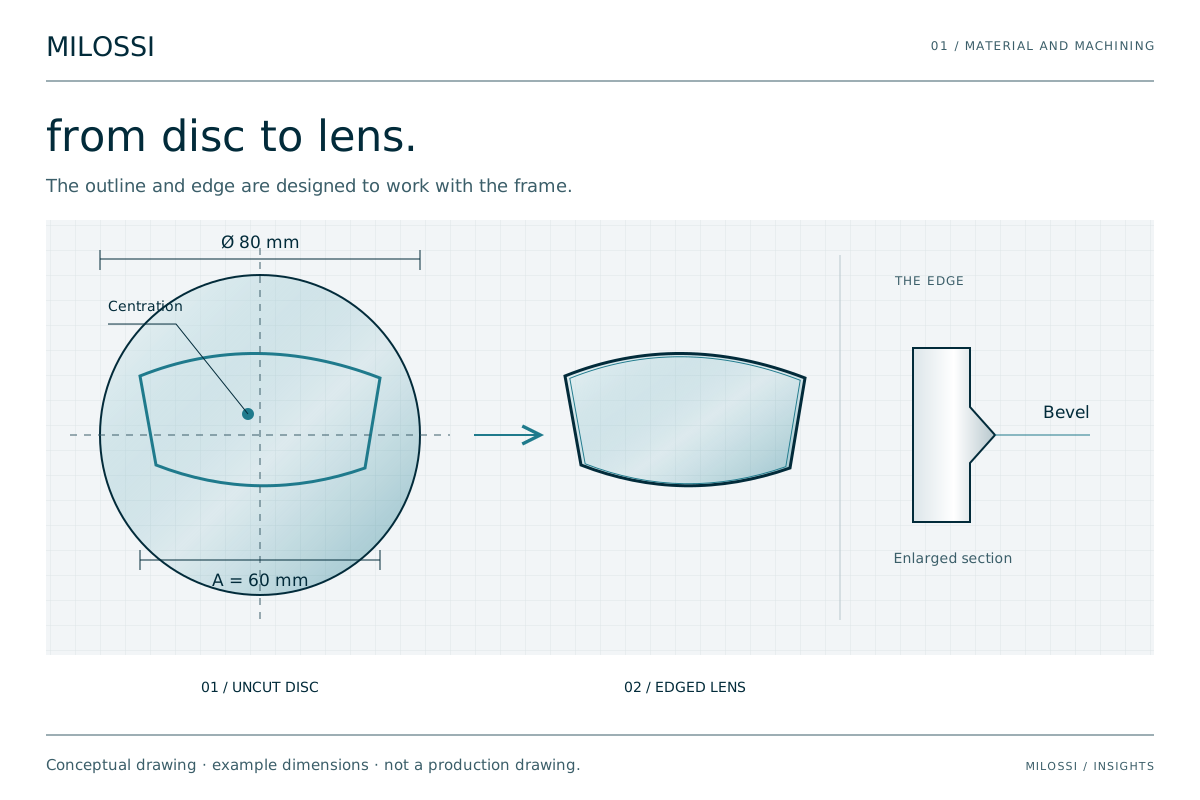
- Define the outline. Obtain it by tracing the frame or from digital data compatible with the equipment.
- Centre and block. Position the lens; for a polarised lens, retain the correct filter orientation.
- Rough and profile. The equipment removes excess material with tools appropriate to the substrate.
- Finish the edge. Produce the bevel, groove or holes required by the mount. Not every material supports the same operations.
- Mount and inspect. Check fit, stresses, surface, orientation and optical performance.
Technical reference for outline and bevel finishing: [12]
The process is not identical for every lens: Japan Eyewear describes sheet cutting and forming for its TAC range. Prescription lenses may require surface generation and polishing before edging. [7]
What to ask the supplier
A useful specification should identify material and construction, available base curves, thickness, usable diameter, tints, light transmission, UV protection, coatings and approved edge operations. To finalise development, we would request mounted samples and test evidence for the final combination of lens, coating and frame.
For PC and nylon, we would start with a suitable hard coat; for CR-39, compare durability with and without hard coating according to use; for TAC, prioritise the complete lamination and surface-protection system. Rear-surface antireflection and easy-clean treatments follow according to the intended experience. Raw-material strength alone does not certify protective eyewear. PPG notes that coatings can alter impact resistance. [8]
Technical sources
Product specifications describe the cited range. Confirm the selected lens, frame and treatments with the supplier.
- ZEISS Sunlens · Polyamide ↗
- ZEISS Sunlens · Polycarbonate ↗
- OptiCampus · Material properties ↗
- ZEISS Sunlens · Sun-lens materials ↗
- Divel Italia · Sun-lens materials ↗
- European Patent Office · TAC–PVA–TAC, EP3871866B1 ↗
- Japan Eyewear · TAC sheets and coatings ↗
- PPG · Trivex ↗
- Mazzucchelli 1849 · Materials and processing ↗
- ASM International · Solvent-induced cracking of polycarbonate ↗
- OptiCampus · Lens design and base curves ↗
- NIDEK · ME-1500 edging and bevels ↗
© 2026 MILOSSI SRL · Editorial edition. Rights reserved. Reproduction of protected content requires authorisation, except for uses permitted by law. For quotations and references: credit MILOSSI and link to the original article.