MILOSSI / LENS NOTES
Polarised lenses: when they help and when to consider alternatives
Fishing, driving, snow and sailing: reducing a reflection can improve vision or remove useful information.
Darkening and polarising are different functions
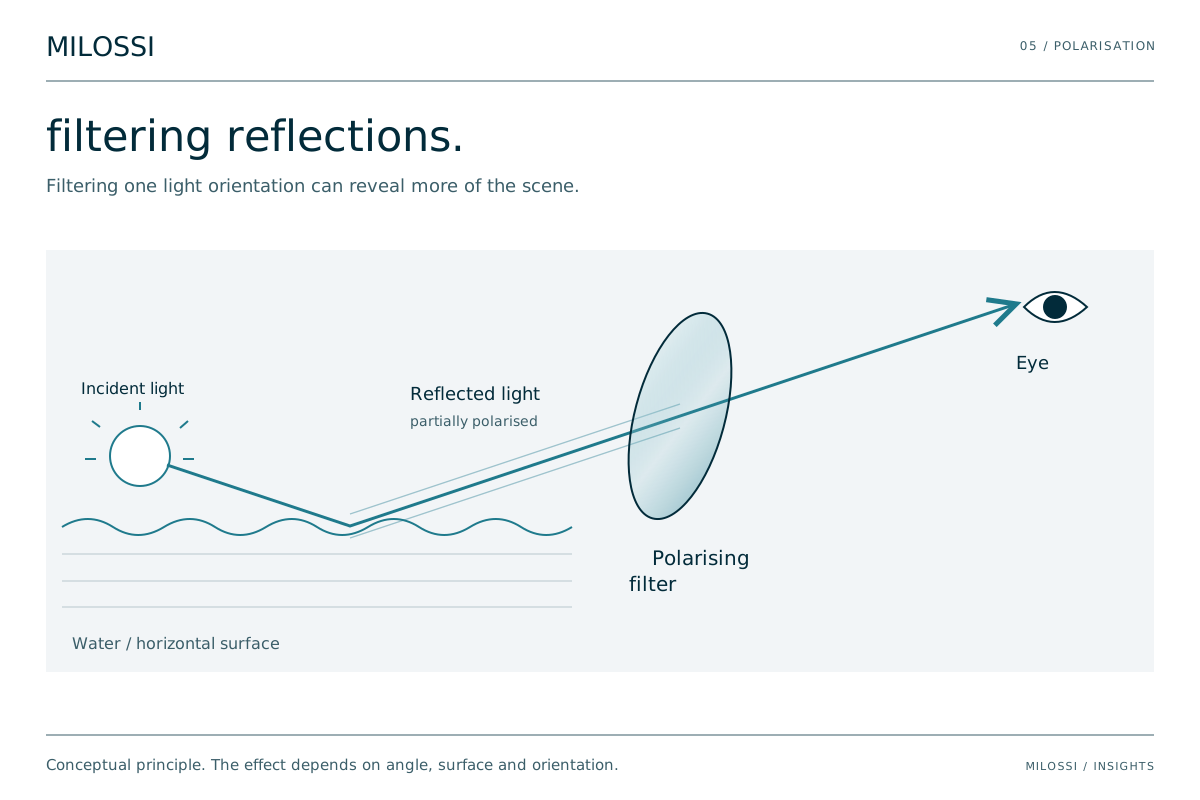
A tinted lens reduces the amount of light reaching the eye. A polarised lens adds a filter that preferentially attenuates certain orientations of light. When light reflects from surfaces such as water, some of it can become polarised; the filter uses this effect to reduce disturbing reflections.
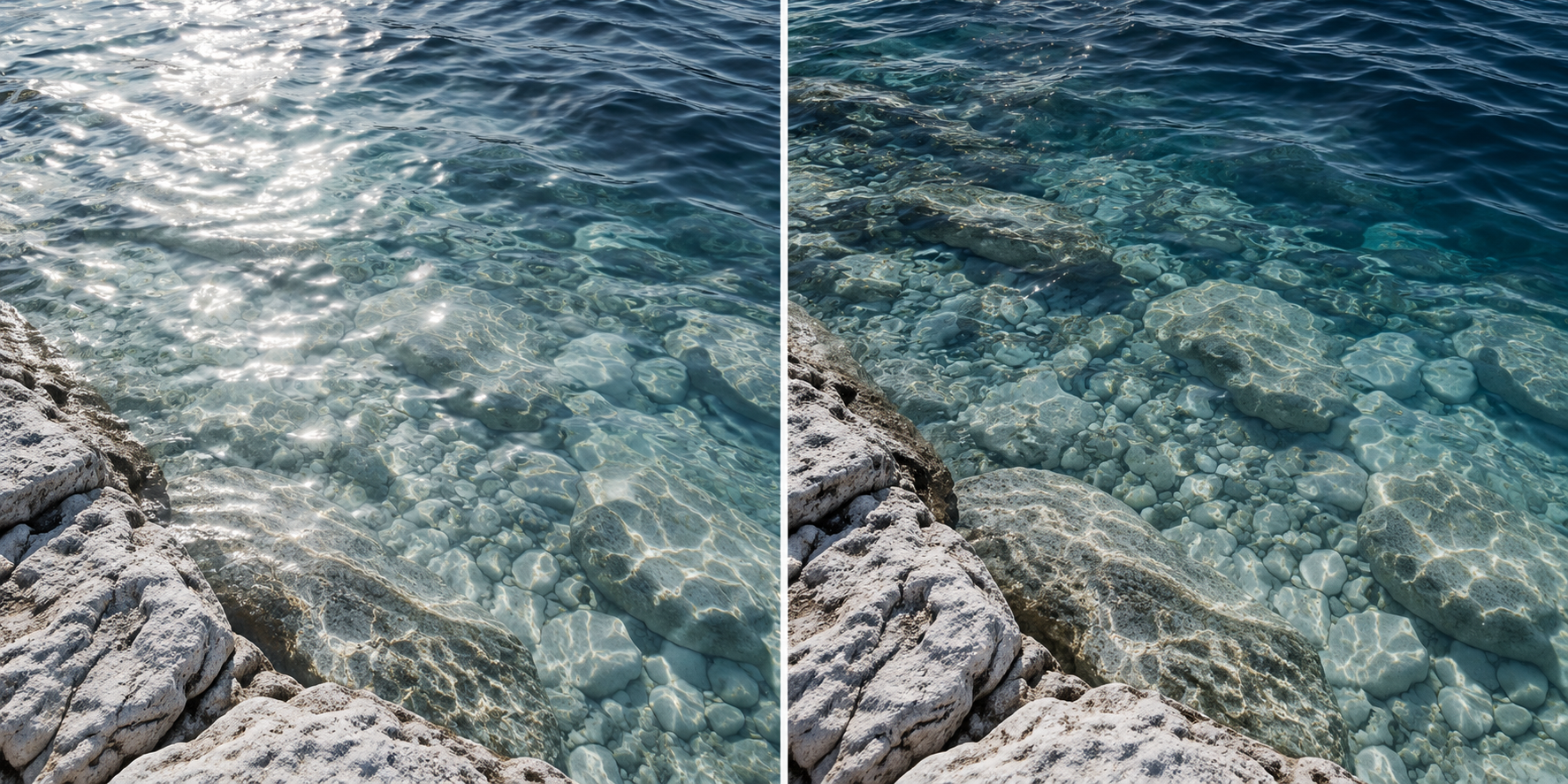
A polarised lens can therefore make it easier to see beneath the water’s surface than another lens of similar darkness. The effect changes with viewing angle, surface type and filter orientation. It does not mean removing every reflection. [1]
In many constructions, a polarising film is integrated or laminated inside the lens. This function can be combined with different materials and coatings: it is neither exclusive to TAC nor a simple surface finish equivalent to antireflection. [2]
A difference you can see
When it can help and when to consider another option
| Situation | Selection criterion |
|---|---|
| Fishing | Polarisation is often useful for reducing surface reflections and seeing into the water, especially in shallow areas. |
| Daytime driving | Can improve comfort against road reflections. Check screens, HUDs, windscreens and signal recognition with the selected lens. |
| Sailing and reading the water | Reflections can convey information about surface conditions. Compare full, partial and no polarisation during the activity. |
| Snow and skiing | There is no single answer. Balance reflections, terrain perception, tint and available light; specific partial-polarisation solutions exist. |
| Cycling, running and golf | Do not choose by sport name alone. Assess sun and shade, terrain reading, useful reflections and device compatibility. |
| Piloting | The FAA advises against polarised lenses because of potential interference with instruments, windscreens and visual cues. |
| Night or low light | Dark sun lenses reduce available visual information. Polarisation does not make them a universal night-vision aid. |
Fishing and sailing illustrate the distinction between “less reflection” and “better information for a task”. ZEISS distinguishes these uses in its water-sports guide. Verification should take place in the actual environment of use. [1] [3] [4]
On snow, not every reflection is a nuisance
Removing reflections can improve comfort in strong sunlight, but some highlights help identify surface changes. Avoid universal rules: not every polarised lens is unsuitable for skiing, and not every polarised lens is the best option.
Julbo distinguishes polarised shields for bright conditions from Glare Control solutions for other situations, including identifying ice patches. This shows that polarisation level, tint and transmission are designed together. Do not assign the same polarisation percentage or behaviour to every lens. [5]
Screens and windscreens: test before deciding
Some LCDs can darken or become difficult to read through a polariser. Tilting your head can change the effect. Stress patterns may also become visible in certain windscreens. The FAA identifies these issues in aviation; for other uses, test the specific combinations rather than assuming every screen will turn black. [4]
For a collection aimed at driving or sailing, we would include device use in prototype testing. We would not consider the issue resolved simply because a brochure says “digital friendly”.
Polarised does not automatically mean more UV protection
Polarisation, UV protection and filter category describe different properties. A non-polarised lens can offer suitable UV protection; a polarised lens still requires that protection to be verified. Colour and mirror finish do not replace this information either. [6]
The best option preserves the information needed for the activity. For a specialist collection, offering two clearly explained configurations may make more sense than promising one solution for everything.
Technical sources
Product specifications describe the cited range. Confirm the selected lens, frame and treatments with the supplier.
© 2026 MILOSSI SRL · Editorial edition. Rights reserved. Reproduction of protected content requires authorisation, except for uses permitted by law. For quotations and references: credit MILOSSI and link to the original article.