MILOSSI / LENS NOTES
Base curves: from flat lenses to wraparound eyewear
How curvature changes an eyewear profile, lens fit and development decisions.
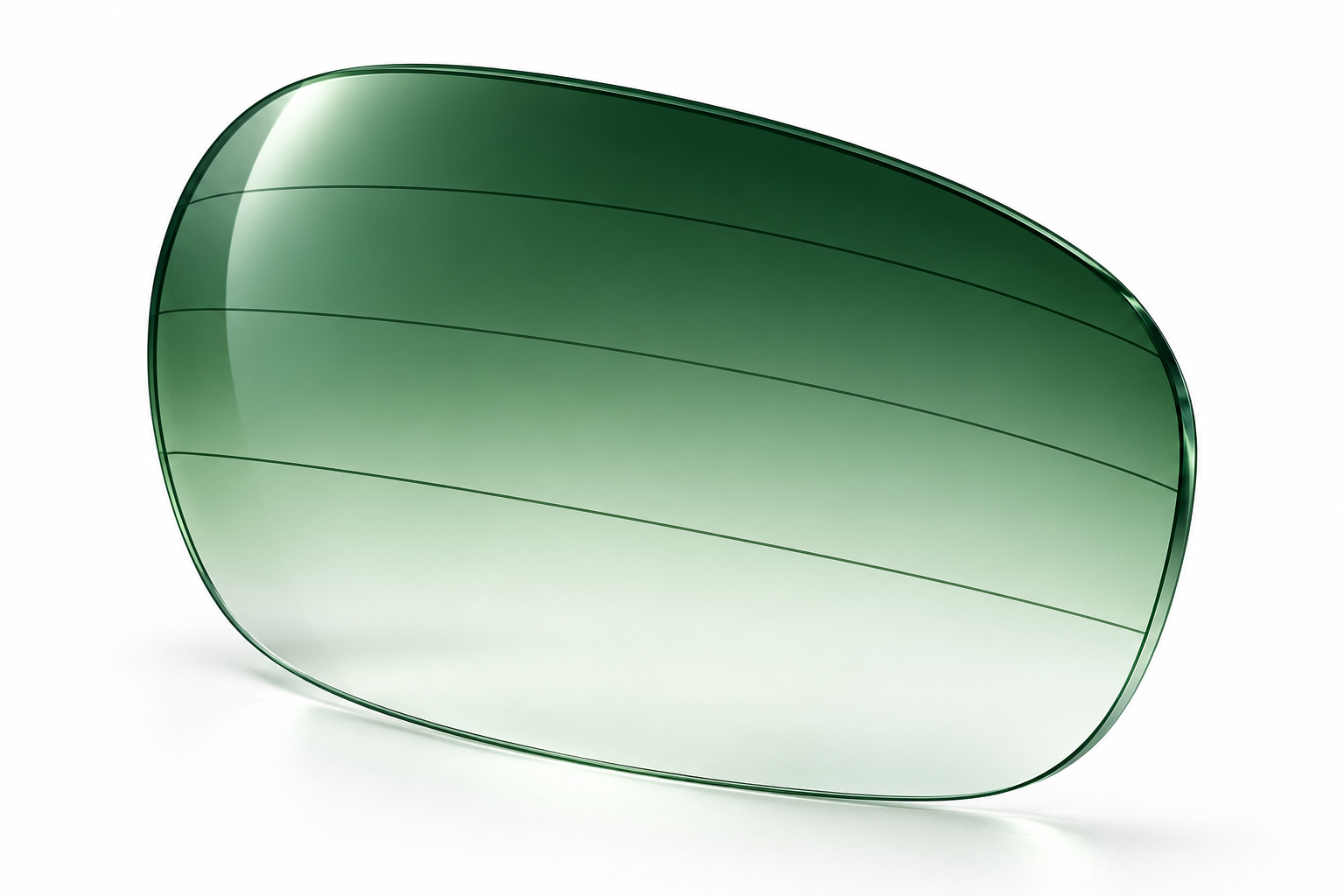
Base curve describes curvature, not prescription power
In sunglass development, base curve usually describes the reference curvature of the lens’s front surface. A low base appears flatter; a high base, more curved. The number helps coordinate lens and frame, but it is not prescription power, radius in millimetres or darkness category.
A non-prescription sun lens can be highly curved. Its design combines surfaces and thickness to achieve the intended optical result. In optical terminology, “plano” can mean zero power even when the piece is not physically flat. [1]
Base 8 and category 3 can coexist in one lens: the first describes geometry; the second, how much visible light it transmits.
From base 0 to base 10
| Nominal base | Typical appearance | Design decision |
|---|---|---|
| 0–1 | Flat or almost flat. | A pronounced frontal appearance. Check rear reflections, position in front of the eye and fit in the frame groove. |
| 2–4 | Low to moderate curvature. | A common candidate for everyday silhouettes. Compare how the volume changes in profile. |
| 6 | More pronounced curvature. | Can provide moderate wrap; the result depends on lens size and frame front. |
| 8 | Highly curved. | Interesting for wraparound projects. Coordinate optics, bevel and position of wear. |
| 10 | Very high curvature. | Requires specific availability and close development of frame, lens and assembly process. |
We would not group bases 6, 8 and 10 as equally “ultra-curved”. The difference is easier to see with a constant width and a side-profile comparison. These are design guidelines; each supplier defines available values and tolerances.
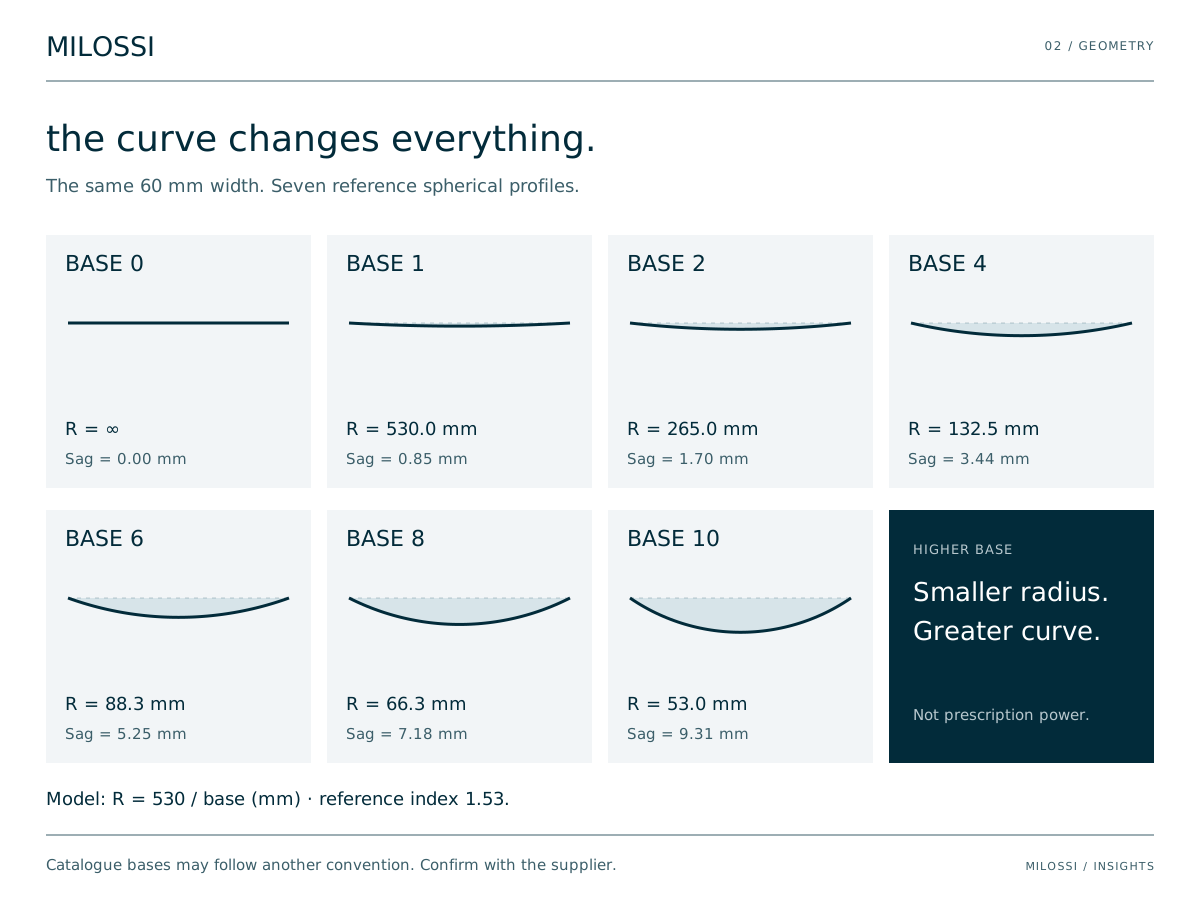
Why a higher base creates a tighter curve
For a spherical surface, radius and curvature are related: the smaller the radius, the tighter the curve. This comparison uses a tool convention with a reference index of 1.53: R = 530 ÷ base, with R in millimetres. Base 6 therefore has an illustrative radius of 88.3 mm; base 8, 66.3 mm; and base 10, 53.0 mm. Base 0 is the flat limit, with infinite radius. [2]
The convention matters. A lens clock can be calibrated for a reference index different from the actual material. A manufacturing order should state nominal base, radius or effective geometry, reference index and tolerance; these drawings should not replace the technical data sheet.
Lens curvature and frame wrap are related, but different
Base curve describes a surface. Eyewear wrap also depends on the angle between the two rims, the bridge, width and how the frame sits on the face. Pantoscopic tilt — the inclination of the front viewed from the side — is another separate parameter.
An attractive CAD curve needs checking in a prototype: clearance from eyelashes and cheeks, stability, lateral coverage and vision when moving the eyes. Wraparound prescription lenses may require compensation for the actual position of wear. Satisloh describes specific calculations to minimise oblique aberrations and adapt lenses to wraparound sports frames. [3]
The edge matters too. NIDEK shows specific processes for high-base lenses, with independent control of the front and rear of the bevel. Forcing a lens into the rim’s shape can introduce stresses; resolve the geometry before assembly. [4]
What to define before manufacturing
- Outline shape and size, together with each surface’s curvature or the supplier’s exact reference.
- Front angle, position of wear and lens-to-eye distance.
- Specified thickness, material and treatment.
- Bevel, groove or fixing method and assembly tolerances.
- Optical verification of the mounted prototype, not just a loose lens.
For a collection, we would develop front and lens together. Choosing the lens last can force changes to the profile, groove or even the shape that made the original design interesting.
Technical sources
Product specifications describe the cited range. Confirm the selected lens, frame and treatments with the supplier.
© 2026 MILOSSI SRL · Editorial edition. Rights reserved. Reproduction of protected content requires authorisation, except for uses permitted by law. For quotations and references: credit MILOSSI and link to the original article.