MILOSSI / LENS NOTES
Categories 0 to 4: how much light a lens transmits
What VLT means, how to choose a filter and why category, colour, UV protection and eye visibility are different decisions.
How much light a lens transmits
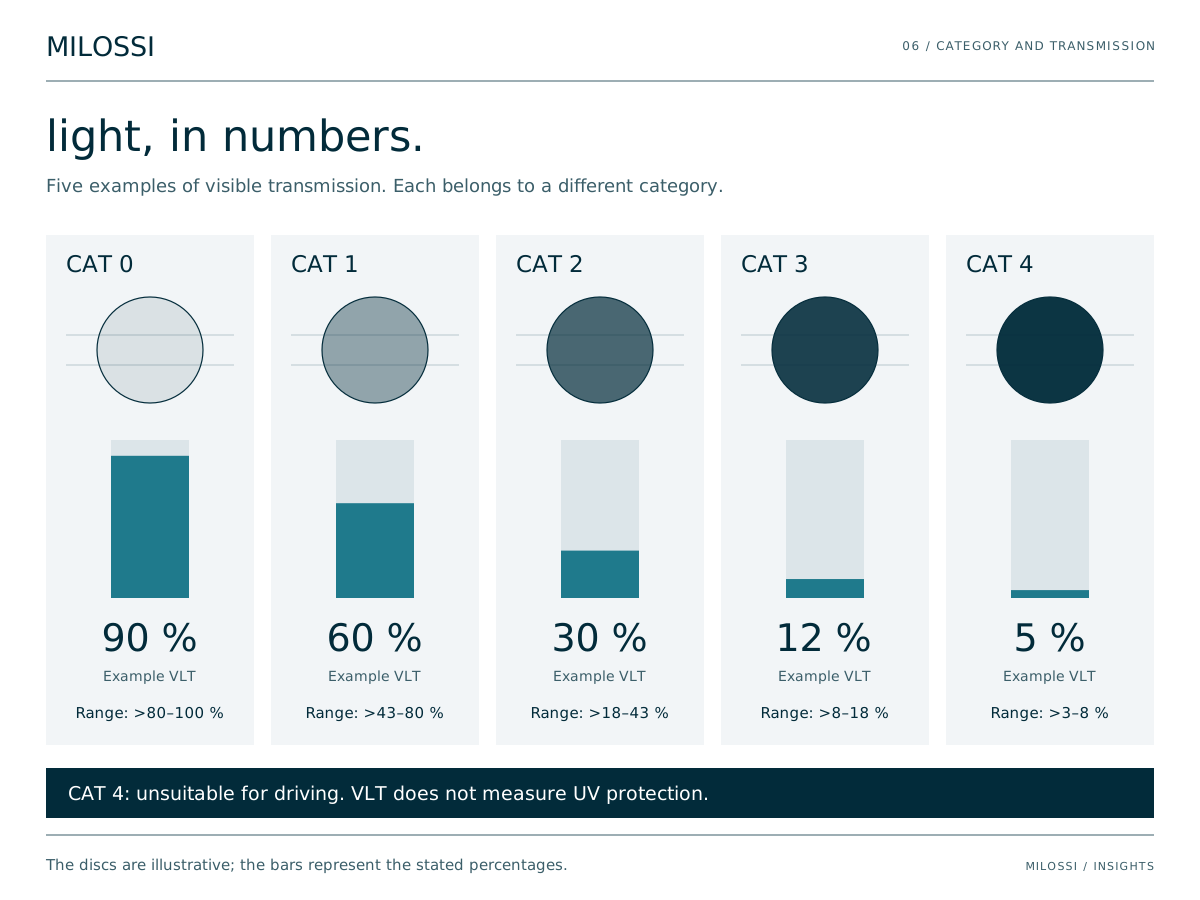
A solar filter’s category indicates a range of visible light transmission, also called VLT or τv. This measurement accounts for how human vision responds to different wavelengths. Lower transmission means less visible light passes through the lens.
A lens with 12% VLT transmits approximately 12% of visible light under the measurement conditions. The remainder is reflected or absorbed. It does not mean “12% protection”, nor does it alone describe how much UV radiation passes through the filter. [1]
The usual scale for general-use sunglasses has five categories: 0, 1, 2, 3 and 4. Five categories does not mean that CAT 5 exists within that scale.
From category 0 to category 4
| Category | Visible light transmitted | Indicative use |
|---|---|---|
| CAT 0 | Over 80%, up to 100% | Clear or very lightly tinted filters; minimal reduction of sun glare. |
| CAT 1 | Over 43%, up to 80% | Light tints for lower brightness and fashion applications. Limited sunlight attenuation. |
| CAT 2 | Over 18%, up to 43% | Medium brightness; a balance between attenuation and visibility. |
| CAT 3 | Over 8%, up to 18% | Strong sunlight; a common choice for daytime outdoor use. |
| CAT 4 | Over 3%, up to 8% | Extreme brightness, for example high mountains and snow. Not suitable for driving. |
Nominal limits from ISO 12312-1:2022. Testing includes conditions, tolerances and specifics such as gradients; this table does not replace product classification. [2]
Does a higher category make the eye less visible?
Under equal conditions, a darker lens usually makes the eye harder to see from outside. But appearance also depends on mirror coating, reflections, colour, angle and facial lighting. Category is not an eye-visibility scale.
In a photo shoot, the same lens can clearly reveal the eyes under one light and conceal them under another. For a collection, we would separately approve the external appearance, the view through the lens and measured VLT. A promise such as “the eyes will not be visible” needs more information than a category number.
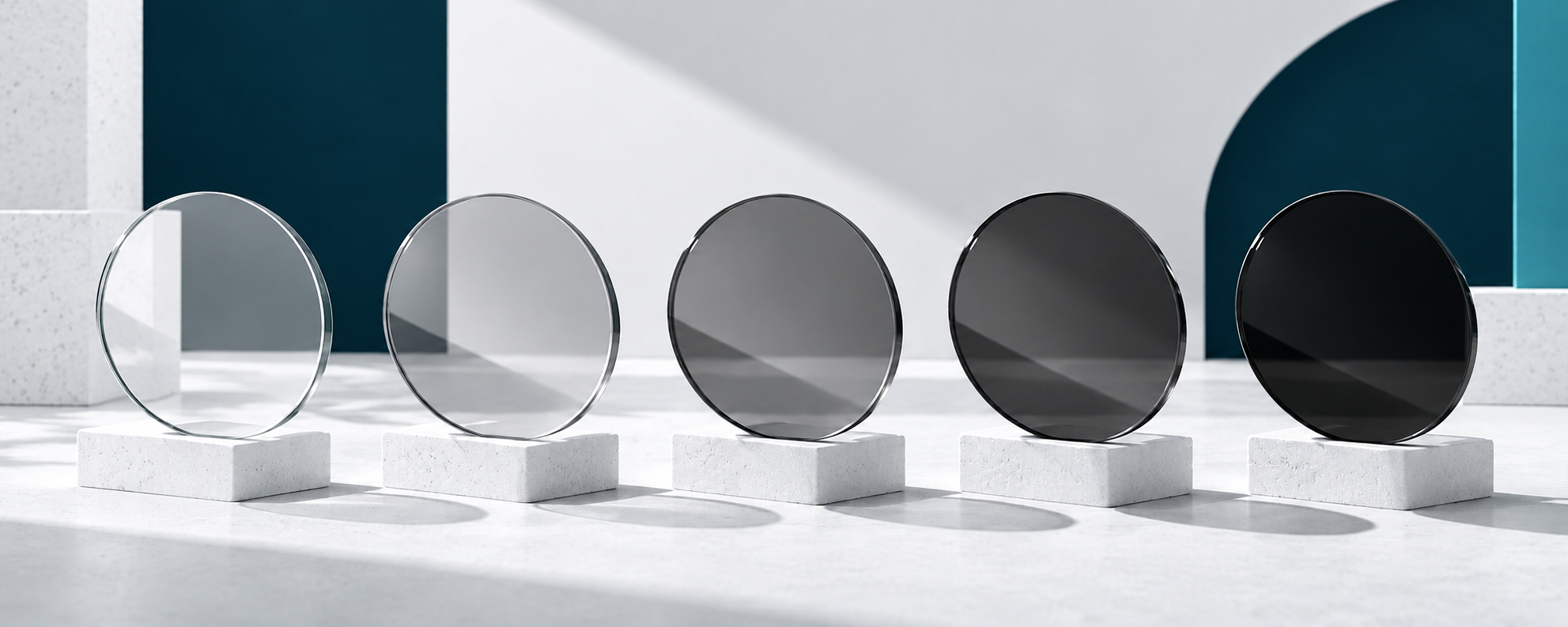
The cover composition shows a visual progression from light to dark. It is an AI-created conceptual image, not tested samples or a calibrated simulation of the five categories.
Category, colour, UV and polarisation are different things
Category describes light quantity; tint describes which parts of the spectrum are transmitted. A grey lens and a brown lens can share a category while producing different colour perceptions. A mirror coating colours the exterior reflection: a lens that looks blue outside can have a grey or brown base. Revo, for example, specifies base colour, mirror and VLT separately. [3] [4]
UV protection must be verified in its corresponding range. Darkness does not equal UV protection, and a clear lens can incorporate suitable UV filtering. Polarisation reduces certain reflections; it does not determine the category either. [5]
CAT 4: useful in extreme light, unsuitable for driving
A category 4 lens transmits very little visible light. It can make sense in exceptionally bright environments, such as glaciers or high snowy mountains, together with appropriate coverage and design. It is not a “more premium” choice for every situation: with less available light, the same filter can make details harder to see. [1]
CAT 4 is not suitable for driving. Nor does CAT 2 or CAT 3 alone guarantee suitability: signal detection and conditions of use must be considered. Dark sun lenses are unsuitable at night or twilight; the standard sets a specific transmission threshold for that use. [6] [2]
Usage information should accompany the product and be easy to find when choosing a lens. A higher category does not represent higher quality: it represents different attenuation.
What a CAT 1–3 photochromic lens means
It describes a lens that changes between a lighter and a darker state within a declared range. It does not mean it always reaches both extremes in every environment or changes instantly. Temperature, available radiation and test conditions influence the result. For driving, its behaviour behind a windscreen also matters. [2] [5]
Using this information to design a collection
One model could offer a light aesthetic version, a sun lens for ordinary daytime use and another intended for a specific environment. Each needs a coherent use description. Changing the commercial colour name is not enough.
The brief should specify target VLT and tolerance, category, transmitted colour, reflected colour, polarisation, UV protection, material and coatings. For visual review, we would use the same face and scene under controlled lighting and add the supplier’s measurement. That way, campaign aesthetics and actual performance tell the same story.
Technical sources
Product specifications describe the cited range. Confirm the selected lens, frame and treatments with the supplier.
© 2026 MILOSSI SRL · Editorial edition. Rights reserved. Reproduction of protected content requires authorisation, except for uses permitted by law. For quotations and references: credit MILOSSI and link to the original article.