MATERIAL NOTES / 01
Cellulose. Pigment. Precision.
How acetate glasses are made
A good frame begins long before the first cut. Follow the material from cellulose to finished eyewear, and discover the decisions that shape its colour, comfort, stability and production cost.
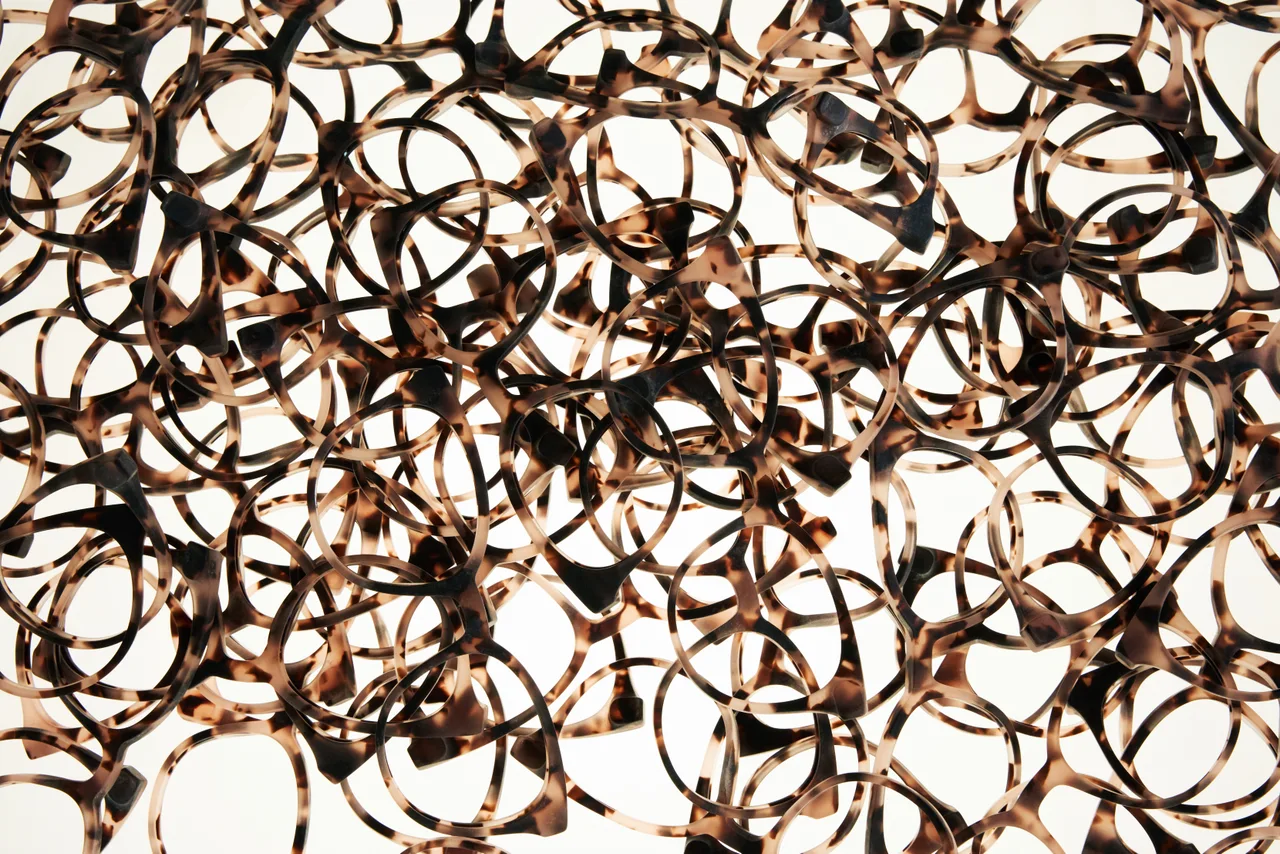
A journey through acetate.
This guide follows sheet-acetate frames. Injected constructions use a different manufacturing route.
01 / Where acetate comes from
Cellulose acetate is a chemically modified cellulose polymer. Its renewable starting material can come from wood pulp and cotton linters. Acetylation transforms purified cellulose into acetate; plasticizers and colourants then help give the material its working properties and appearance.
For a brand, the useful question is precise: which formulation, which supplier, which sheet and which batch? “Premium acetate” on its own is not a specification.
02 / Colour is part of the material
Transparent, opaque, tortoiseshell, striped, gradient or multilayer: acetate offers a remarkable colour vocabulary. Coloured mixtures and chips can create patterns through the material; layered constructions reveal different colours as the frame is sculpted. The effect must be evaluated on a cut and polished sample, not only on a flat swatch.
03 / From mixture to sheet
Sheets can be made through block, extrusion and lamination processes. In block production, coloured material is assembled and pressed, then sliced. Laminations combine layers. The selected route affects pattern, thickness and subsequent processing.
04 / Which types of acetate exist?
Separate three decisions: formulation, sheet construction and colour. A tortoiseshell pattern says little about the plasticizer or recycled content. A bio-based formulation says little about how a multilayer design will look after machining.
Common options include standard plasticized cellulose acetate, stiffer formulations such as HX, bio-based plasticizer formulations such as M49, and sheets made with Acetate Renew. Select the grade for the required thickness, construction and performance, then validate it on the actual design.
For bio-based grades, ask for the exact composition and supporting documentation. For Acetate Renew, recycled content is certified through mass-balance allocation: describe that method accurately. Bio-based, recycled, biodegradable and compostable are different claims; none automatically describes the finished pair of glasses.
05 / Drying, maturation and conditioning
These are separate stages. Sheet maturation belongs to the material manufacturer’s process; workshop conditioning helps the received sheets reach a suitable environment before machining. Maison Mata, for example, describes several weeks of drying and maturation. That is a documented example, not a universal duration for every acetate.
Mazzucchelli recommends storage at 20–25 °C and 45–55% relative humidity, and hanging individual sheets for a couple of days before processing. Follow the current instructions for the specific grade. Forced drying can make the material brittle.
Agree a written conditioning and stabilization protocol with the factory: material code, thickness, temperature, humidity, duration and dimensional checks. A calendar alone cannot prove that a sheet or a frame is ready. Production lead time is a different number.
06 / Cutting the frame into existence
An approved drawing defines the front, bridge, lens openings and temples. Blanks are cut from the sheet and machined, often with CNC equipment, to develop the geometry. The chosen orientation of a pattern matters just as much as its colour.
Before approving a batch, compare the prototype with the drawing and the intended wearer. Look at bridge support, temple length, frame width and the space available for the specified lenses. A beautiful front still needs a comfortable fit.
07 / Curves, hinges and assembly
The front and temples acquire their final curvature through controlled forming and adjustment. Hinges, temple cores and other components must suit the construction. Assembly sequences vary between factories; what matters is that the approved sample and production specification agree.
08 / A finish you can feel
Tumbling, sanding and polishing progressively refine the surfaces. Hand finishing gives attention to edges and transitions. Excessive material removal can soften a deliberate line or change a critical dimension: approve both the look and the geometry after finishing.
09 / How to choose good acetate and verify the frame
Choose a documented material that works for the model. Ask for the manufacturer, material and colour codes, batch traceability, nominal thickness and tolerances. Evaluate a physical sample under consistent lighting, then machine and polish it before committing to the colour.
For the finished frame, agree acceptance criteria for dimensions, symmetry, surface defects, hinge operation, lens retention and fit. Validate production-representative samples and the testing required for the destination market. Keep an approved reference sample and agree how defects, replacements and spare parts will be handled.
10 / How long does production take?
For planning with MILOSSI, allow approximately 60–90 days for acetate-frame production when the selected material is in stock. If the material must be produced, allow around 40 additional days: approximately 100–130 days in total. Factory capacity, design and availability can change the schedule.
These are planning references from our work, not guaranteed supplier terms or drying cycles. Confirm when the clock starts, after sample approval and order confirmation, and quote development, custom-colour approvals, shipping and customs separately.
11 / Minimum orders: test before scaling
Some factories ask for 300 frames per model and 100 per colour; others ask for twice that: 600 per model and 200 per colour. These are examples encountered in sourcing, not an industry-wide rule. Both conditions usually apply together: 300 frames can mean one model in three colours of 100 each.
A factory has an incentive to fill its production capacity. Your brand needs to protect its cash and validate its product. Test fit, finish, durability and market response before committing to large quantities. Request a pilot batch where feasible and compare the total commitment, not just the unit price.
12 / Custom acetate: what do 30 kg really make?
A custom colour, pattern or lamination can become part of a collection’s identity. In the custom developments we discuss, 30 kg per colour is a useful starting reference for the material minimum. Confirm it with the supplier for the specific recipe, thicknesses and construction; it is separate from the frame factory’s minimum order.
30 kg do not automatically mean 600 frames. That result requires a gross material allowance of 50 g per complete frame, including cutting waste. The model’s size, design, front and temple thicknesses, pattern orientation, cutting layout and rejected pieces all affect the yield. The weight of the finished frame is not the material consumption.
A worked example: assume one rectangular front blank of 150 × 55 × 6 mm and two temple blanks of 150 × 12 × 4 mm. At an assumed density of 1.30 g/cm³, they total 83.07 g: 30,000 ÷ 83.07 ≈ 361 frames before further losses. The blank lengths and widths are illustrative; Mazzucchelli publishes a density range of 1.28–1.32 g/cm³, and JIMEI lists 6 mm front and 4 mm temple sheets in its catalogue. These references are not a verified yield for your design.
Before ordering, ask the factory for usable sheets by thickness, a cutting plan and consumption per accepted frame. Confirm whether the 30 kg minimum can be split between front and temple thicknesses. A shortage of one thickness cannot be solved simply by having extra kilograms of the other.
Same 30 kg. Different assumptions.
| Gross allowance | Theoretical frames |
|---|---|
| 50 g / frame | 600 |
| 75 g / frame | 400 |
| 100 g / frame | 300 |
Explore material yield
An estimate with your assumptions.
Use the factory’s gross allowance, including cutting waste. The default 83.07 g is the illustrative blank calculation above. Add a rejection percentage only if it is not already included in that allowance.
Material (kg) × 1,000 ÷ gross grams per frame, then deduct additional rejects and round down.
13 / The right material. The right factory.
At MILOSSI we work regularly with Mazzucchelli 1849, which has production facilities in Italy and China, and with JIMEI, with whom we have maintained a close relationship for many years. These relationships help us discuss materials, colours and the feasibility of each collection directly.
We help brands find a factory in Asia or Europe that fits their product, quality expectations and realistic order volumes. Material selection, prototypes, testing, quantities and production planning belong in the same conversation. The best factory is the one that fits your project.
Common questions
How many frames can be made from 30 kg of acetate?
It depends on the design and gross material consumption. At 50 g per frame, 30 kg give a theoretical 600 units; at 75 g, 400; at 100 g, 300, before any additional rejection allowance. Confirm the cutting plan and allocation between front and temple thicknesses with the factory.
Is drying the same as production lead time?
No. Material maturation, workshop conditioning and frame production are separate stages. The 60–90 day production reference assumes material availability; it is not a universal drying instruction. Follow the material supplier’s grade-specific protocol.
Can a new brand order a custom acetate colour?
Yes, subject to supplier feasibility and minimums. Approve the physical colour, sheet construction and finished-frame sample first. Compare the custom-material commitment with stock colours, and confirm both the material minimum and the frame factory’s order minimum.
Research & studio experience
Technical references support the material discussion. Production times, order examples and supplier relationships reflect MILOSSI’s project experience and must be confirmed for each order. Photographs illustrate manufacturing stages; they do not identify a specific material supplier.
Explore our eyewear design workSee the development in practice.
Eyewear design services- From Sketch to Frame
From Camila Cisneros’s first sketch to an organic metal frame. Explore MILOSSI’s eyewear design, technical development, sampling and production work for SAJU.
- Destinos
A signature LIVO frame, reinterpreted through laminated acetate. Discover JULES Destinos: Bonito, Amazônia and Natal, where colour, memory and material meet.